


Do you struggle to remember things? Do you feel like you are constantly forgetting important information? If so, don't worry - you're not alone. Many people find it difficult to remember things. There are a number of memory techniques that can help make remembering facts easier. In this blog post, I will discuss some of the most effective memory techniques and how to use them. So, if you're looking for ways to improve your memory, keep reading!
But before we talk about memory techniques, let's talk about the need for memorization.
Why memorize?
There is a lot of debate on whether or not you should memorize things. Some people swear by it, while others say that there are better ways to learn and remember information. Here are some reasons why you should memorize:
- To reason, you need facts. When you commit data to memory, you can play with information in your head. The more information you have in your memory, the more you can use it to reason. Memorizing facts gives you a bank of material you can use to form or test a hypothesis.
- Foundation for higher-order thinking. Only with a factual base that you believe can you effectively use your higher levels of thinking. Memorizing makes information readily available for learning deeper and making connections to new material. You can not be creative or innovative with information you do not have.
- Organise your knowledge. To memorize any information, you need to first organize it into little chunks that flow in a logical order. In turn, it gives you a structure and context in which to put any new information. Memorizing a set of facts means that new information can be inserted in an orderly way, sandwiched, or used to enhance other facts in an organized framework.
- It stays with you. You can now look up anything thanks to technology, but that consumes time and working memory. By committing facts to memory, you are much more efficient and can work around the working memory limitations. Even if you don't understand it the first time, memorizing information allows you to return to it. And research has shown that the retrieval practice will significantly increase learning. Having to pull the information out and make meaning is how learning occurs.
Keep in mind that memorization is different from rote learning. Rote learning is learning by repetition without any regard for understanding. It is not the primary goal of learning, but it is a critical component.
Memory techniques and learning
When you first learn any new information, it is put in your working memory. Working memory is very good at receiving data from our long-term memory and manipulating it. Unfortunately, your working memory can only hold between five to seven items.
To make learning effective, you need to move the information you have learned to long-term memory. Encoding is the process of transferring information from working memory to long-term memory. If you encode correctly, you will have an easier time remembering the information in the future.
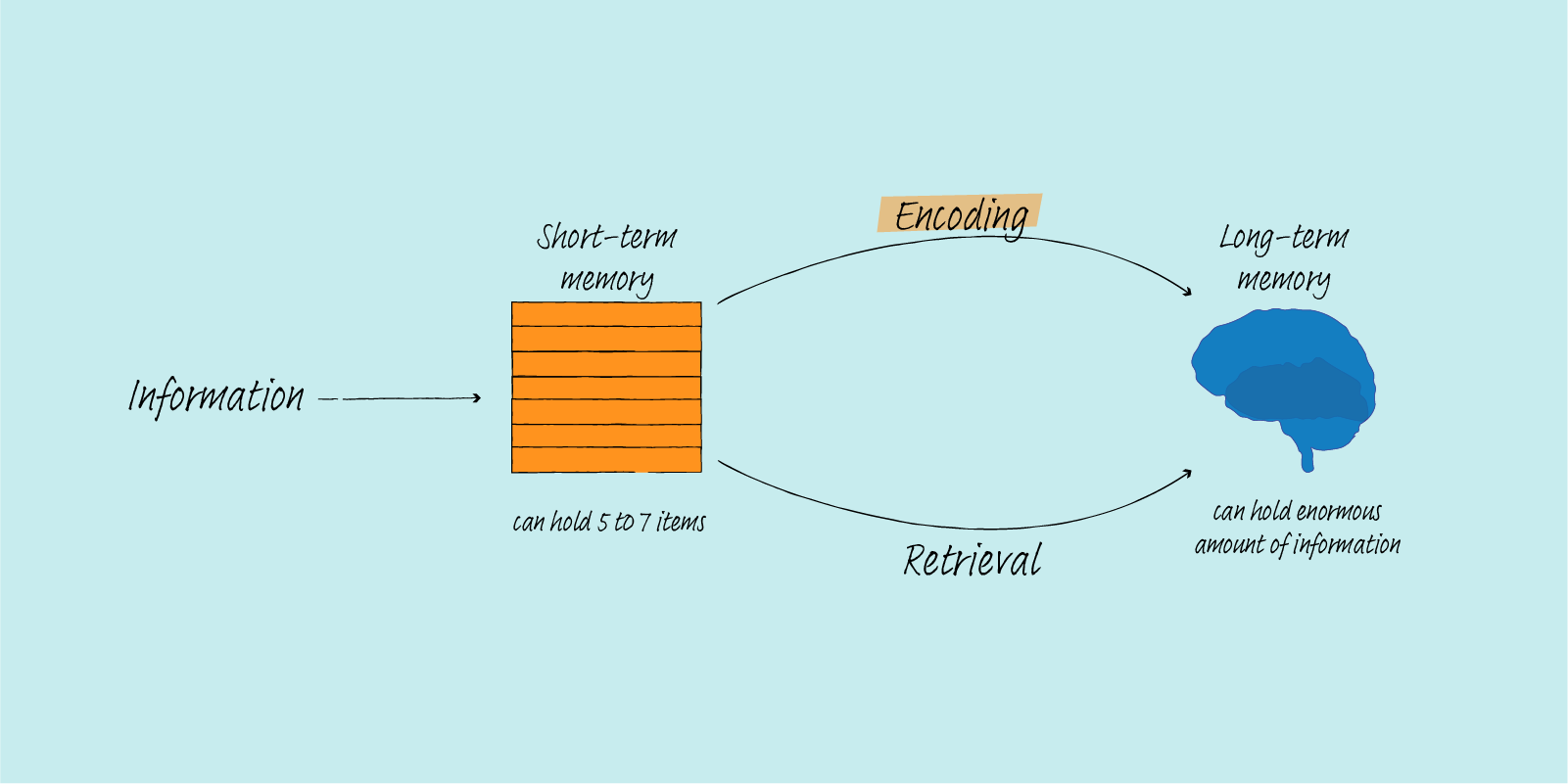
Memory techniques or mnemonic devices are among the best techniques to help you encode information. Other encoding techniques are chunking, self-referencing, and spacing.
Effective memory techniques
There are many different types of memory techniques, and people have used them for centuries to help remember everything from essential facts to the order of cards in a deck. In this article, I will focus on the three most effective memory techniques you can use when you learn.
First of all, the basis of all memory techniques is story, imagination, and characters. To remember better, you need to be able to make up stories, imagination, and characters in your mind. The more vivid and wild, and unusual you make your images association, the more likely you can remember information. Mundane information will not excite your brain, but wild stories and wild imagination will.
Other memory techniques rely on your ability to create stories, images, and characters. Luckily everyone can make these things up. And the more often you do this, the better you get at creating this.
Now that you understand the basics of memory techniques let us move on to the more advanced technique: memory palace, visual alphabet, and Dominic system.
Memory palace
Nearly everyone has heard of the phrase "memory palace." Still, not many people know what it is or how to use it. A memory palace is a technique used to improve your memory by associating objects with specific locations. You attach knowledge to the locations by imagining events there. It can be used for short-term and long-term memories and is the most effective technique available.
To "build" a memory palace, you need to choose a location. Potential memory palaces can be your homes, schools, workplaces, parks, neighborhoods, libraries, malls, gyms, etc. You can turn any location you are familiar with into a memory palace. But to be effective, you should choose locations carefully. According to an ancient Roman textbook, "Rhetorica ad Helenium," you should choose locations that are far away from distractions. The locations should be well lit. They should be pretty distinct from each other. Locations should be moderate in size and have a moderate distance between them.
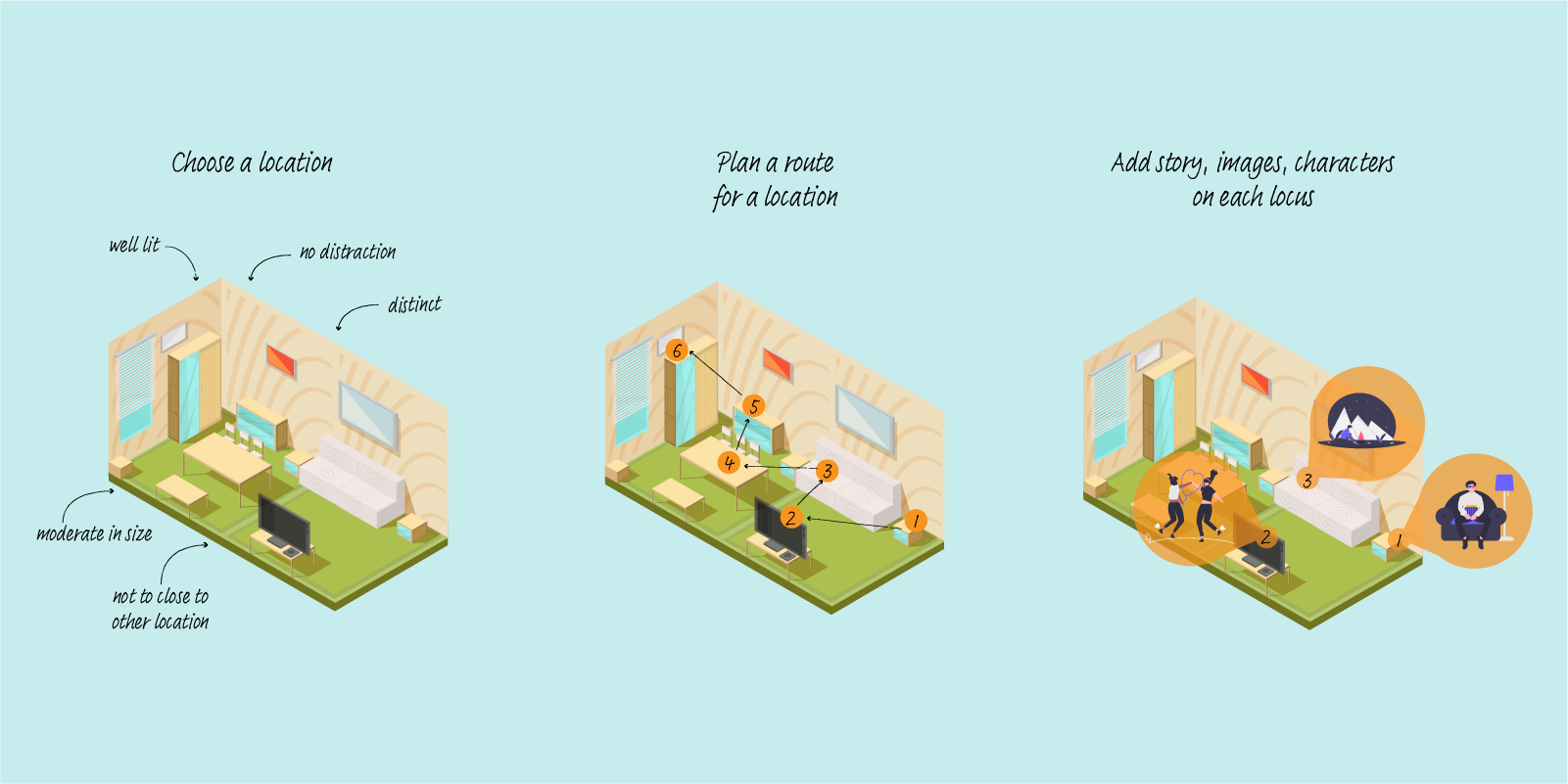
Once you have a location you want to turn into a memory palace, you can plan out the whole route. For example, gate, front porch, front door, shoe rack, bathroom, living room, etc. When you have a list that you want to memorize, take one or two items and place a mental image of them in each locus of your memory palace. Exaggerate the visualization of the information and have them interact with the location. Even better if you can turn the images alive with your senses.
Visual alphabet
When it comes to memorizing a list, there is no better technique than the visual alphabet. This method uses images to represent each letter of the alphabet. By creating a mental picture associated with each letter, it becomes much easier to remember items on a list. For example, the letter A might be represented by an image of an apple, B could be a banana, and so on. Here is the visual alphabet that I have created and used.
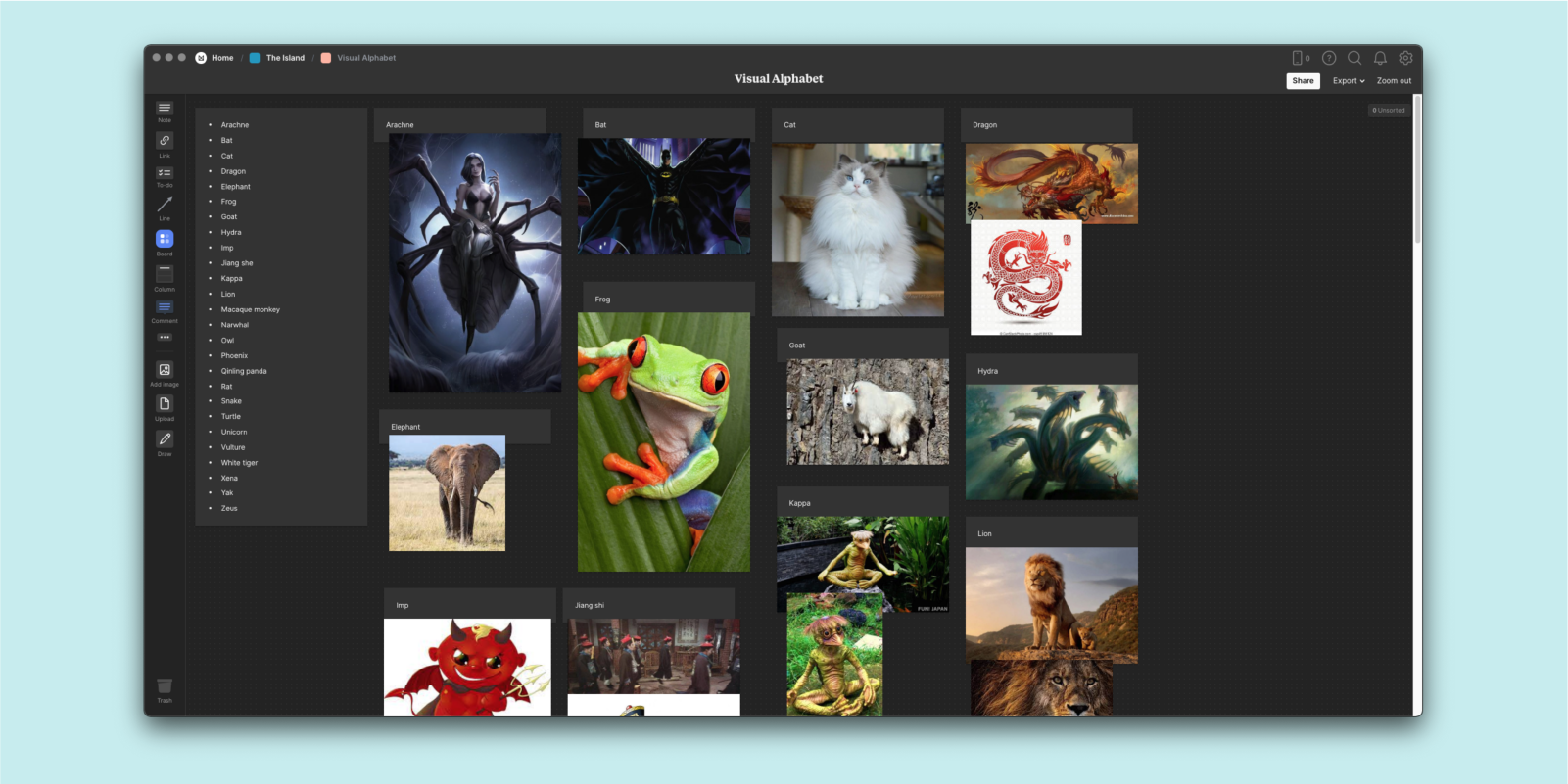
Most of the time, I use this technique in conjunction with other memory techniques. For instance, when I want to memorize a piece of information that contain sub-components. I use the memory palace to store the main points. If there are sub-components, I will just use this technique to create a list and place it on a locus.
Dominic system
The Dominic system is a memory technique invented by Dominic O'Brien. It is a system for memorizing long sequences of numbers by first converting them into pairs of letters. And then associating those letters with easier-to-remember people and actions.
The digit-letter association used by the Dominic system are :
| Number | Mnemonic |
| 1 | A |
| 2 | B |
| 3 | C |
| 4 | D |
| 5 | E |
| 6 | S |
| 7 | G |
| 8 | H |
| 9 | N |
| 0 | O |
For instance, 04 is "OD," which becomes Oscar De La Hoya punching a sandbag. The number 62 is "SB" and could be Sandra Bullock driving a bus.
To use this system, I have made visualization for numbers from 00 - 99. To help me remember this better, I dump them into my Anki and review the numbers every day. Here is an example of my first 20 visualizations.
| # | Visualization | # | Visualization |
| 00 | Obelisk eating boar | 10 | Maradona scoring a goal using his hand |
| 01 | Asterix putting on his feathered hat | 11 | Andre Agassi swinging a tenis racket |
| 02 | Obi-wan Kenobi wielding a lightsaber | 12 | Astro boy flying |
| 03 | Trinity kicking a cop | 13 | Al Capone spraying bullet using a tommy gun |
| 04 | Oscar De La Hoya punching a sandbag | 14 | Anthony Davies trimming his unibrow |
| 05 | Oedipus blinding his eyes | 15 | Amelia Earhart flying an aeroplane |
| 06 | OJ Simpson trying on gloves | 16 | Arnold Schwarzenegger performing a squat |
| 07 | Oscar the Grouch sitting on a trash can | 17 | Ariana Grande singing into a mic |
| 08 | Oliver Hardy swinging a plank | 18 | Adolf Hitler raising his hand |
| 09 | Owen Wilson wearing a cowboy suit | 19 | Alfred Nobel blowing up a mine using dynamite |
Long numbers are chunked in 4s. The first 2 digits are converted into a person, and the second 2 digits become an action. To remember the year 1619, I imagine Arnold Schwarzenegger riding a motorcycle.
To remember a long number like 17191902, for example, you need to chunk them into 2763 and 6339. Then convert them into AGAN ANOB. Using my own list, I can create a story of Ariana Grande blowing up a mine with dynamite and getting cut in half by Alfred Nobel, who wields a lightsaber.
Tips for using memory techniques effectively
Memory techniques can be a great way to boost your ability to remember information. However, using them effectively can be tricky. Here are some tips for getting the most out of your memory techniques, according to Alex Mullen, a memory athlete and a medical student from mullenmemory.com.
- Do not memorize everything using memory techniques. Memory techniques are just tools. If you can intuitively remember a concept, you don't need to utilize memory techniques. Use your critical thinking about the material. Think about what is worth memorizing and what is not.
- Do not encode everything using images. Maintain an optimal mix of understanding/intuition coupled with memory techniques as a supplement
- Use memory palace to structure material. The memory palace is incredibly good at helping you organize and sequence information.
- Use spaced repetition software to maintain your mnemonics. Images can get faded away in your memory. Spaced repetition software like Anki can help you manage your memory. Spaced repetition is a critical component of building lasting retention.
Summary
Memory techniques are an effective way to learn and remember facts. The three techniques I have shared should help you get started with improving your memory. Have you tried any of these methods before? What has been your experience?
Comments
Join the discussionNo comments yet. Be the first to comment.


